A kitchen can have beautiful cabinets, gorgeous countertops, and brand-new flooring, but if the lighting is wrong, the entire room can still feel unfinished.
Too little light makes cooking and cleanup difficult. Harsh fluorescent fixtures can make even a newly remodeled kitchen feel dated. A single ceiling light may brighten the center of the room while leaving countertops, corners, and the pantry frustratingly dark.
The best kitchen lighting does more than help you see.
It changes how the space feels, supports how you use it, and highlights the design choices you worked so hard to select.
That is why lighting should be planned as part of the kitchen remodel, not treated as an afterthought.
Good Kitchen Lighting Comes in Layers
One fixture cannot do every job in a kitchen.
A well-designed kitchen usually combines several layers of light, with each one serving a different purpose.
Ambient lighting provides comfortable, overall illumination throughout the room.
Task lighting makes food preparation, cooking, and cleanup easier.
Accent lighting adds warmth and highlights cabinetry, tile, architectural details, or display areas.
Decorative lighting brings personality to the room through pendants, chandeliers, and statement fixtures.
When these layers work together, the kitchen can feel bright and energetic in the morning, comfortable while preparing dinner, and soft and welcoming when friends gather around the island.
This layered approach creates the balance between functionality and ambiance that is often missing in an older kitchen.
It Is Time to Say Goodbye to Fluorescent Light Boxes
Many older Arizona kitchens still rely on long fluorescent tubes, bulky ceiling light boxes, or one central fixture to illuminate the entire room.
These fixtures may produce plenty of light, but they do not always produce pleasant or evenly distributed light.
Fluorescent bulbs can feel harsh, cast unflattering tones, create shadows, and give the kitchen an outdated commercial appearance. Even after new cabinets and countertops are installed, an old fluorescent box can make the room feel like the remodel stopped at the ceiling.
Modern LED ceiling lighting offers a much cleaner solution.
Strategically placed recessed LED lights can distribute light throughout the kitchen instead of concentrating it in one spot. They can illuminate walkways, work zones, sinks, appliances, and gathering areas without visually cluttering the ceiling.
The result is a kitchen that feels brighter, cleaner, and more open.
Bright Ceiling LEDs Create the Foundation
Ceiling lighting is the foundation of a good kitchen lighting plan.
Bright recessed LEDs provide the general illumination needed for cooking, cleaning, unpacking groceries, and moving safely through the room. They are energy efficient, long lasting, and available in different color temperatures and brightness levels.
Placement is just as important as the fixture itself.
Recessed lights should be positioned according to the kitchen layout, not simply installed in a perfect grid across the ceiling. Cabinets, countertops, appliances, walkways, and work zones should all influence the lighting plan.
A ceiling light placed behind you may cause your body to cast a shadow directly onto the countertop. A light placed more thoughtfully can illuminate the work surface instead.
During a kitchen remodeling project, planning the ceiling lighting alongside the cabinetry and electrical work helps create a much more functional finished space.
Under-Cabinet Lighting Makes a Bigger Difference Than You Think
Upper cabinets can block ceiling light and cast shadows directly onto the countertops where much of the kitchen work happens.
Under-cabinet lighting solves that problem by putting light exactly where it is needed.
Under-cabinet lighting also adds another layer of ambiance.
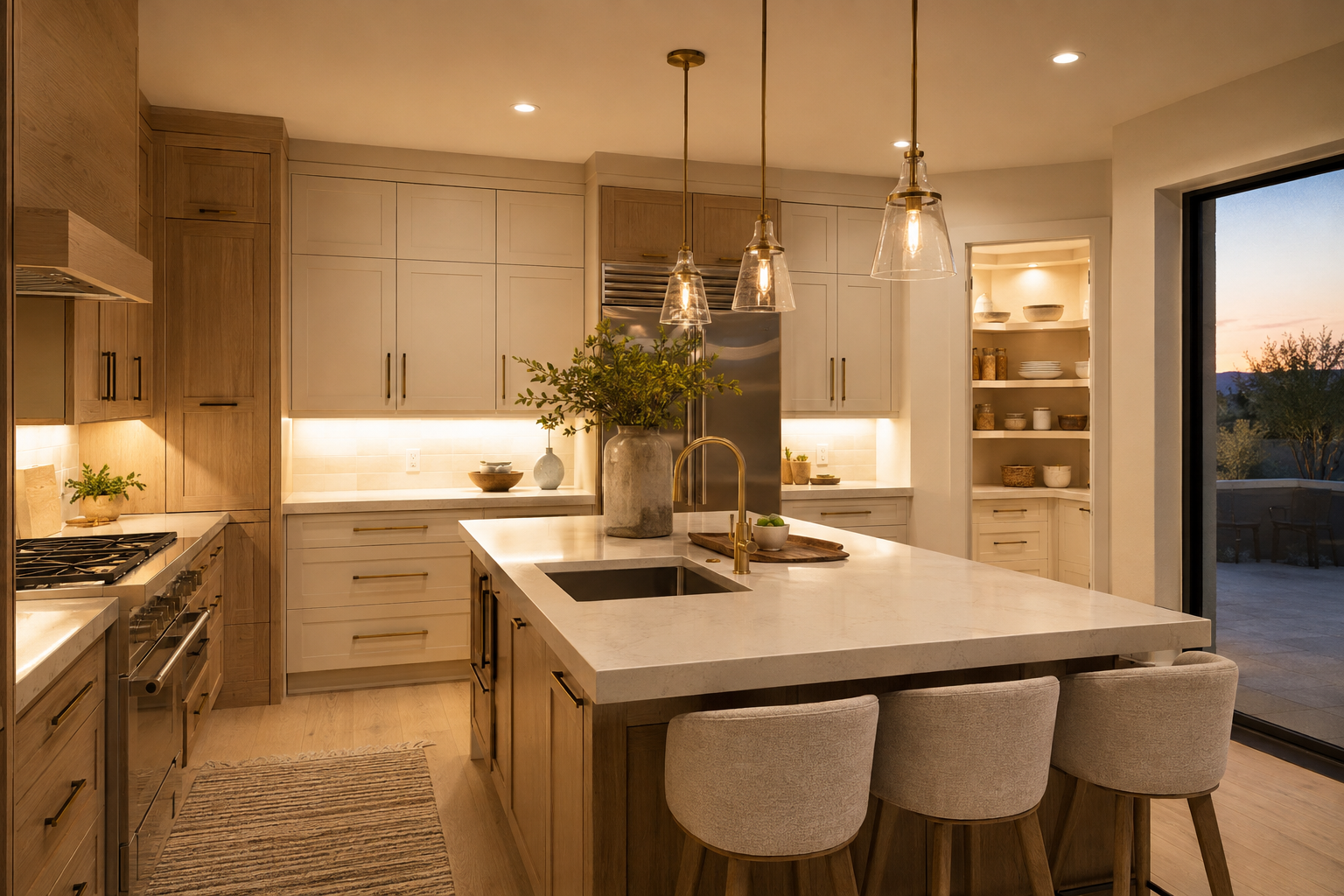
With the main ceiling lights turned off or dimmed, the glow beneath the cabinets can make the kitchen feel warm, polished, and inviting. It is especially lovely in the evening when you want enough light to move comfortably through the room without turning on every bright overhead fixture.
We especially like under-cabinet LEDs paired with a dimmer.
Full brightness is useful during meal preparation and cleanup. A lower setting creates a softer atmosphere for entertaining, enjoying a quiet dinner, or winding down at the end of the day.
A dimmer transforms under-cabinet lighting from a practical feature into one of the most versatile design elements in the room. You can prepare and chop food safely, read recipes, clean your countertops, and find things in the spice rack!
Yes, Your Pantry Needs Its Own Lighting
Pantry lighting is one of those details homeowners do not always think about until they experience a pantry that is properly illuminated.
Without dedicated lighting, deep shelves and lower corners can become dark hiding places for ingredients.
You know the pasta sauce is in there somewhere. Finding it should not become a small daily scavenger hunt.
A pantry deserves more than whatever light happens to spill in from the kitchen.
Motion-activated lighting is especially convenient. The pantry illuminates as soon as the door opens or someone walks inside, so there is no fumbling for a switch while carrying groceries.
For a walk-in pantry, lighting should reach the shelves and work surfaces rather than only illuminating the center of the floor. In smaller cabinet-style pantries, integrated lighting can make the storage feel more organized and easier to use.
It is a relatively small improvement that makes the kitchen function better every day.
- A bright overhead LED fixture
- Recessed lighting
- Vertical lighting beside shelving
- LED strips beneath shelves
- Motion-activated lighting
- A door-activated switch
Dimmers Let One Kitchen Have Several Personalities
Your kitchen does not need the same amount of light at every hour.
Bright lighting is helpful when you are cooking, cleaning, or unpacking groceries. That same brightness may feel unnecessary when you are enjoying coffee before sunrise or talking with friends around the island after dinner.
Dimmers give you control over the room’s mood.
Instead of thinking about kitchen lighting as simply on or off, dimmers allow you to adjust each layer for the moment.
Ideally, different lighting zones should have separate controls.
The ceiling lights, under-cabinet lights, pendants, and accent lighting do not all need to operate from one switch. Separate zones allow homeowners to use exactly the amount and type of light they need.
This flexibility is what turns a brightly lit workspace into a comfortable part of the home. Bright, energized lighting works for cooking. Comfortable, balanced light feels right for family meals. Soft, warm lighting enhances the mood for entertaining. Low, peaceful lighting in the evening sets the tone for winding down.
Pendant Lights Add Function and Personality
Pendant lights over an island or peninsula can provide focused illumination while also becoming part of the kitchen’s design.
They can introduce color, texture, shape, and personality. Depending on the style of the kitchen, pendants might feel sleek and modern, warm and organic, classic and understated, or bold and sculptural.
Their size, spacing, height, and brightness all matter.
Fixtures that are too small can feel lost over a large island. Fixtures that are too large or installed too low may block views and make the kitchen feel crowded.
The goal is to provide useful light while keeping the room visually open and balanced.
Pendant lights are one of the places where lighting becomes more than a practical necessity. They become part of the overall design story.
Integrity Contracting’s interior design services can help homeowners coordinate lighting with cabinetry, hardware, countertops, flooring, and the surrounding rooms so the finished kitchen feels intentional rather than pieced together.
The Color of the Light Matters Too
Not all white light looks the same.
Some LED bulbs produce a warm, soft glow, while others create a cooler and brighter appearance. Choosing the wrong color temperature can affect how the entire kitchen feels. It may even change the way cabinet colors, paint, countertops, flooring, and tile appear.
Warm white lighting tends to feel comfortable and inviting.
Cooler white lighting can feel crisp and energizing but may become harsh if it is overused.
Many homeowners prefer a balanced color temperature that provides good visibility while still complementing the warmth of the home.
Consistency also matters.
Mixing very warm under-cabinet lights with cool blue ceiling lights can make the kitchen feel disconnected. Choosing compatible color temperatures helps all the lighting layers work together.
This decision is best made alongside the other material selections so you can consider how the light will interact with the actual colors and finishes in the room.
Lighting Should Be Planned Before Construction Begins
Lighting affects electrical wiring, switch locations, ceiling work, cabinetry, drywall, and sometimes the overall kitchen layout.
Waiting until the cabinets are installed to decide where under-cabinet lighting should go can create unnecessary complications. The same is true for pantry lighting, island pendants, dimmers, and additional ceiling fixtures.
Early planning also helps hide wires, transformers, and power supplies so the finished result looks clean.
A thoughtful lighting plan is one of the details experienced remodelers consider because it affects both the construction process and the way the completed kitchen functions. It is also one of the things homeowners sometimes forget during a remodel.
The Best Kitchen Lighting Is Beautiful and Useful
Kitchen lighting should not force you to choose between ambiance and functionality.
You can have bright LED ceiling lights that make cooking and cleaning easier.
You can have an illuminated pantry that helps you find what you need.
You can install under-cabinet lighting on a dimmer for both countertop visibility and a beautiful evening glow.
And you can finally say goodbye to the fluorescent tubes and giant glowing light box in the middle of the ceiling.
The right lighting plan allows your kitchen to change with you throughout the day. It can feel bright, efficient, welcoming, relaxed, and beautiful, sometimes all within the same evening.
At Integrity Contracting, we help homeowners think through the details that make a remodeled kitchen work better, not just look newer. From cabinetry and layout to electrical planning and lighting, every choice should support how you actually live in the space.
If you are planning a kitchen remodel in Scottsdale, Paradise Valley, Tempe, Mesa, Chandler, Gilbert, or the surrounding East Valley, contact Integrity Contracting to begin creating a kitchen that looks beautiful in every light.